Loading...
This record has been deleted. Since it is linked to a published record, it is available here for reference purposes only.
Click here to view the deleted recordThis document has been updated. This is not the latest published version. Click here to view the latest version of the record.
Virtual Library Resource
(VLR)
last updated: 24 Jan 2018
Introduction to Access and Benefit-Sharing and the Nagoya Protocol: What DNA Barcoding Researchers Need to Know
EN
- Academic or research institute
50 Stone Road East
Guelph,
OntarioN1G 2W1, Canada
Phone: +1 519 824 4120,
Fax:
Email: genericemail@notavailable,
Website: https://www.uoguelph.ca/,
Secretariat of the Convention on Biological Diversity
(SCBD)
ABSCH-ORG-SCBD-238920-1
This document has been updated. This is not the latest published version.
Click here to view the latest version of the record.
- UN and other specialized agency of the UN Common System
413. St-Jacques Street, Suite 800
Montreal,
QuebecH2Y 1N9, Canada
Phone: +1(541)288-2220,
Fax: +1(514)288-6588,
Email: secretariat@cbd.int,
Website: http://www.cbd.int,
2017-01
EN
Original document
EN
This is an open access publication distributed under the terms of the Creative Commons Attribution License (CC BY 4.0), which permits unrestricted use, distribution, and reproduction in any medium, provided the original author and source are credited. The Secretariat of the Convention on Biological Diversity would appreciate receiving a copy of any publications that use this document as a source.
EN
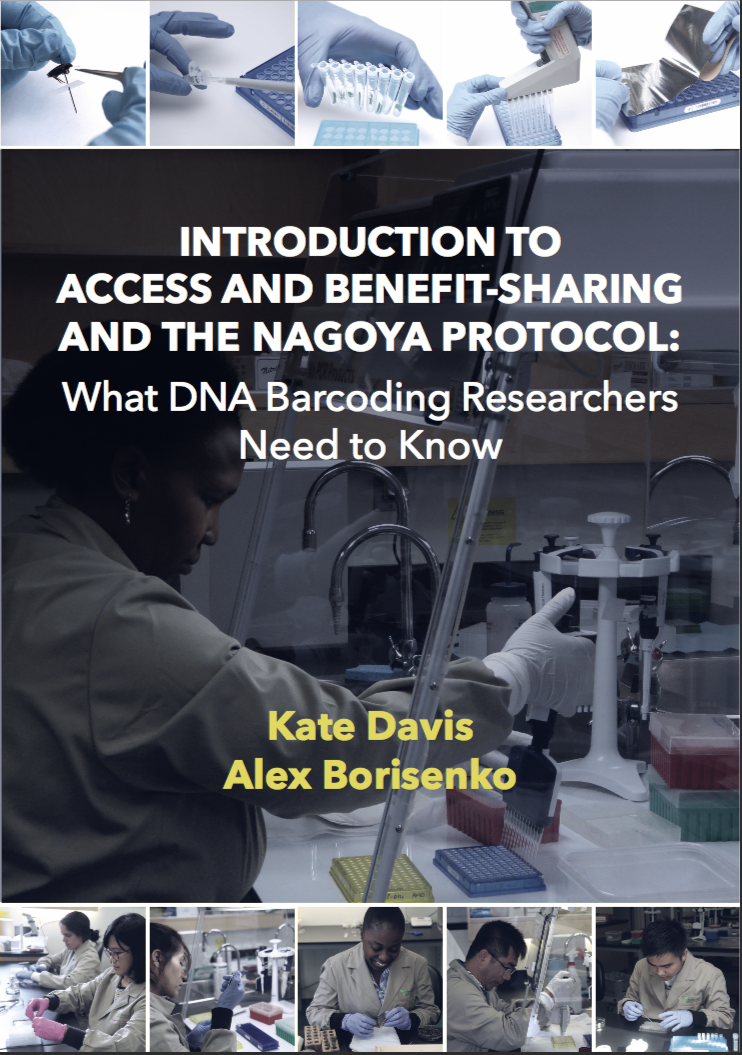
This e-book explains the basic framework of access and benefit-sharing (ABS) under the Convention and the Nagoya Protocol. The book is intended for ‘DNA barcoders’ – researchers and practitioners using DNA-based approaches, such as DNA barcoding, for the identification of organisms. It aims to help them understand how access and benefit-sharing relates to their work and the steps to take to avoid problems. It also points to opportunities provided by the Nagoya Protocol for researchers and practitioners to raise awareness of their work and identify for themselves the specific practices within their field as these relate to access and benefit-sharing.
EN
- Aichi-T2. Integration of biodiversity values
- Aichi-T9. Invasive Alien Species
- Aichi-T16. Nagoya Protocol on ABS
- Aichi-T19. Biodiversity knowledge
- GBF-T14. The multiple values of biodiversity are integrated into decision-making at all levels
- GBF-T06. Reduce rates of introduction and establishment of invasive alien species by 50%
- GBF-T13. Fair and equitable sharing of benefits from genetic resources, digital sequence information and associated traditional knowledge
- GBF-T20. Capacity-building and development, technology transfer, and technical and scientific cooperation for implementation is strengthened
- GBF-T21. Data, information and knowledge for decision-making is available
Migrated information
Format: E-learning module/course/e-book
Format details: Available as an advanced book or PDF document; PDF requires Acrobat Reader for viewing.
Government officials
National/Federal
Sub-national
Research/Academia
Ex-situ collections
Expertise Level: Beginner
EN
Format: E-learning module/course/e-book
Format details: Available as an advanced book or PDF document; PDF requires Acrobat Reader for viewing.
Target Groups
Government officials
National/Federal
Sub-national
Research/Academia
Ex-situ collections
Expertise Level: Beginner
Loading...


