Loading...
This record has been deleted. Since it is linked to a published record, it is available here for reference purposes only.
Click here to view the deleted recordThis document has been updated. This is not the latest published version. Click here to view the latest version of the record.
Virtual Library Resource
(VLR)
last updated: 18 Oct 2017
BioTrade and access and benefit sharing policymakers and regulators: From concept to practice
EN
2017-01
EN
UNCTAD, 2017
EN
Material in this publication may be freely quoted or reprinted, but acknowledgement is requested, together with a copy of the publication containing the quotation or reprint to be sent to the UNCTAD secretariat.
EN
- http://unctad.org/en/Pages/Home.aspx [ English ]
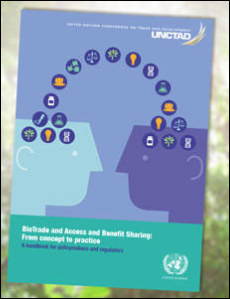
This handbook addresses some of the practical opportunities and challenges regarding access and benefit by presenting the story of BioTrade as a concrete approach for advancing the implementation of Sustainable Development Goal 15, the Convention of Biological Diversity (CBD) and the Nagoya Protocol's objectives, namely conservation of biodiversity, sustainable use and benefit sharing. In doing so, it offers a practical and easy way to understand some of the key issues policymakers and regulators may need to consider when developing and implementing access and benefits sharing (ABS) and BioTrade measures, and projects, in compliance with related international frameworks. The handbook has been structured to highlight key issues and challenges on the ABS and BioTrade interface, with suggestions and recommendations at the end of each section for both regulators and policymakers. A distinction is made between a regulator (i.e. a person who mainly applies a law or regulation) and a policymaker, who develops the rules and frameworks – often these two roles coincide.
Comprising nine sections, the handbook provides a glossary, a series of annexes with relevant case studies and two sets of checklists to guide policymakers and regulators. Boxes and tables further illustrate practical examples and complementary information, which will assist regulators in their decision making and policymakers in developing policies and frameworks.
EN
- Global
- Aichi-T3. Incentives
- Aichi-T16. Nagoya Protocol on ABS
- Aichi-T17. NBSAPs
- GBF-T16. Sustainable consumption choices are enabled, and food waste reduced by half
- GBF-T18. Reduce harmful incentives by at least $500 billion per year
- GBF-T15. Businesses assess and disclose biodiversity dependencies, impacts and risks, and reduce negative impacts
- GBF-T13. Fair and equitable sharing of benefits from genetic resources, digital sequence information and associated traditional knowledge
- GBF-T22. Ensure participation, justice, and rights for indigenous peoples and local communities, women, youth persons with disabilities and environmental defenders
- GBF-T20. Capacity-building and development, technology transfer, and technical and scientific cooperation for implementation is strengthened
- GBF-T21. Data, information and knowledge for decision-making is available
Migrated information
Format: Text document (e.g. adobe acrobat reader or Word)
Civil society organizations
Government officials
National/Federal
Sub-national
Indigenous peoples and local communities
Inter-governmental organizations
Private Sector
Research/Academia
Expertise Level: Advanced
EN
Format: Text document (e.g. adobe acrobat reader or Word)
Target Groups
Civil society organizations
Government officials
National/Federal
Sub-national
Indigenous peoples and local communities
Inter-governmental organizations
Private Sector
Research/Academia
Expertise Level: Advanced


