Loading...
This record has been deleted. Since it is linked to a published record, it is available here for reference purposes only.
Click here to view the deleted recordThis document has been updated. This is not the latest published version. Click here to view the latest version of the record.
Virtual Library Resource
(VLR)
published: 05 Oct 2018
last updated: 10 Oct 2018
Stakeholder participation in policy on access to genetic resources, traditional knowledge and benefit-sharing
EN
80-86 Gray's Inn Road
London,
WC1X 8NH,
Phone: +44 (0)20 3463 7399,
Fax:
Email: inforequests@iied.org,
Website: https://www.iied.org/,
2001-01
EN
- 9096IIED.pdf [ English ]
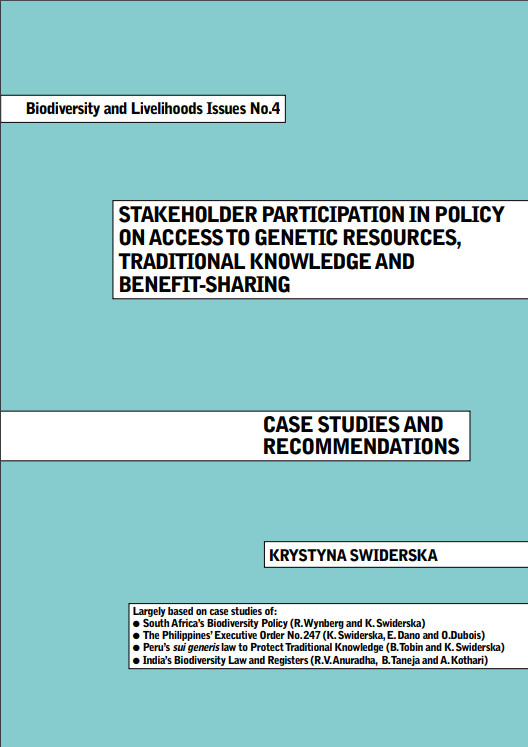
The report focuses on the development of national policy to implement the third objective of the Convention on Biodiversity, which requires the benefits from the commercial and scientific use of genetic resources to be shared fairly and equitably. It presents the main findings of four case studies of stakeholder participation in the development of policy on access to genetic resources and related traditional knowledge. -South Africa’s biodiversity policy (Rachel Wynberg and Krystyna Swiderska)-Peru’s sui generis regime to protect traditional knowledge (Brendan Tobin and Krystyna Swiderska)- the Philippines’ E.O. No. 247 on access to genetic resources (K. Swiderska, E. Dano and O. Dubois)- India’s biodivesity law and community registers (R.V. Anuradha, B. Taneja and A. Kothari)The studies examine the strengths and limitations of the participatory processes, drawing on the views of a range of in-country stakeholders. Based on these studies, the report provides recommendations for securing effective participation in the development of policy on access and benefit sharing, and on the protection of traditional knowledge of indigenous and local communities.
EN
- Peru
- Aichi-T16. Nagoya Protocol on ABS
- GBF-T13. Fair and equitable sharing of benefits from genetic resources, digital sequence information and associated traditional knowledge
Migrated information
Format: Text document (e.g. adobe acrobat reader or Word)
Civil society organizations
Government officials
National/Federal
Sub-national
Indigenous peoples and local communities
Research/Academia
EN
Format: Text document (e.g. adobe acrobat reader or Word)
Target Groups
Civil society organizations
Government officials
National/Federal
Sub-national
Indigenous peoples and local communities
Research/Academia


